Ibuprofen Prices, Trend, Chart, Market Analysis and Foreacast Q1 2026 | ChemAnalyst
- Jun 23
- 6 min read
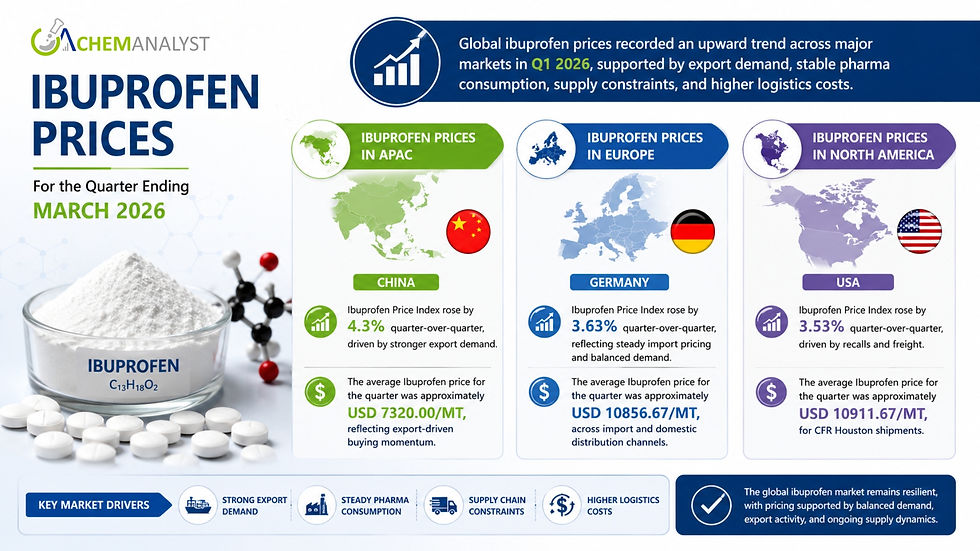
According to ChemAnalyst, The Ibuprofen prices witnessed a positive trend across major global markets during the first quarter of 2026, supported by a combination of export demand, stable pharmaceutical consumption, logistics costs, and supply-side challenges. As one of the most widely used non-steroidal anti-inflammatory drugs (NSAIDs), ibuprofen remains a crucial active pharmaceutical ingredient (API) for the healthcare industry, maintaining consistent demand from pharmaceutical manufacturers worldwide.
The quarter ending March 2026 experienced moderate price growth in Asia Pacific (APAC), Europe, and North America, with each region responding to different market fundamentals. While China benefited from stronger export demand, Germany recorded gains due to balanced imports and domestic consumption. Meanwhile, the United States saw price increases influenced by product recalls and elevated freight expenses.
Global Ibuprofen Market Analysis
The global ibuprofen market continued to display resilience during Q1 2026 despite ongoing supply chain adjustments and changing trade patterns. Healthcare demand remained stable across both developed and emerging economies, supporting procurement activities throughout the pharmaceutical sector.
Several factors contributed to the overall increase in ibuprofen prices:
Rising export orders from Asian manufacturers
Stable pharmaceutical production activities
Higher logistics and freight costs
Balanced inventories in Europe
Product recalls affecting supply availability in North America
Continuous demand from over-the-counter (OTC) medicine manufacturers
These factors collectively strengthened market sentiment and maintained upward pricing momentum across international markets.
Get Real Time Online for Ibuprofen prices: https://www.chemanalyst.com/Pricing-data/ibuprofen-1331
Ibuprofen Prices in APAC
China Ibuprofen Price Trend
China remained one of the most influential suppliers in the global ibuprofen market during Q1 2026. The country experienced a noticeable increase in prices as export activities accelerated and overseas buyers increased procurement volumes.
During the quarter:
Ibuprofen Price Index increased by 4.3% quarter-over-quarter
Average Ibuprofen price reached approximately USD 7,320.00 per metric ton
The primary factor supporting this increase was stronger export demand from international pharmaceutical manufacturers seeking reliable API supplies.
Chinese producers witnessed improved order books from Europe, North America, and Southeast Asia, encouraging higher production utilization rates. Export-driven buying activity significantly tightened available inventories, leading suppliers to adjust quotations upward throughout the quarter.
Export Demand Supports Market Growth
China continues to dominate the global ibuprofen API supply chain due to its large-scale manufacturing capacity and competitive production costs.
During Q1 2026:
Export shipments remained active
International procurement increased steadily
Manufacturing operations maintained healthy utilization rates
Stable raw material availability supported continuous production
Strong international buying momentum allowed manufacturers to negotiate improved selling prices without significantly affecting supply continuity.
APAC Market Fundamentals
Apart from exports, regional pharmaceutical demand remained relatively stable. Healthcare manufacturers continued purchasing ibuprofen for tablet, capsule, suspension, and combination drug production.
Additional market drivers included:
Improved pharmaceutical manufacturing activity
Stable feedstock availability
Consistent domestic healthcare consumption
Expansion of generic medicine production
These factors reinforced positive market conditions throughout the quarter.
Ibuprofen Prices in Europe
Germany Ibuprofen Price Trend
The European ibuprofen market experienced moderate price appreciation during Q1 2026, supported by balanced supply-demand fundamentals and steady import pricing.
During the quarter:
Ibuprofen Price Index increased by 3.63% quarter-over-quarter
Average Ibuprofen price reached approximately USD 10,856.67 per metric ton
Unlike APAC, where exports drove the market, Germany's price movement reflected stable import costs combined with balanced domestic pharmaceutical demand.
Stable Imports Maintain Market Balance
European pharmaceutical companies continued sourcing ibuprofen APIs from international suppliers while maintaining adequate inventory levels.
Import channels remained operational without major disruptions, allowing manufacturers to fulfill production requirements efficiently.
Key market characteristics included:
Stable import pricing
Balanced inventory management
Consistent pharmaceutical manufacturing
Moderate procurement activity
This balance prevented excessive price volatility while still allowing gradual price increases throughout Q1.
Pharmaceutical Demand Remains Strong
Ibuprofen continues to be widely used in:
Pain relief medications
Fever reduction products
Anti-inflammatory treatments
Prescription pharmaceutical formulations
Over-the-counter healthcare products
Steady consumption from these applications maintained healthy procurement activity across European pharmaceutical companies.
Healthcare spending and seasonal medicine demand also supported continuous purchasing throughout the quarter, contributing to positive market sentiment.
Ibuprofen Prices in North America
USA Ibuprofen Price Trend
The United States recorded another quarter of price growth, driven primarily by supply disruptions and logistics challenges rather than demand expansion.
During Q1 2026:
Ibuprofen Price Index increased by 3.53% quarter-over-quarter
Average Ibuprofen price reached approximately USD 10,911.67 per metric ton (CFR Houston)
Although demand remained relatively stable, product recalls and elevated freight expenses significantly influenced market pricing.
Product Recalls Impact Supply
Several pharmaceutical recalls reduced immediately available inventories within the market, encouraging buyers to secure replacement supplies through additional procurement activities.
As available supplies tightened, suppliers responded with higher quotations to reflect changing market conditions.
Market participants reported:
Reduced spot availability
Increased procurement urgency
Higher replacement purchasing
Improved supplier negotiating power
These developments contributed to sustained upward pricing throughout the quarter.
Freight Costs Continue to Influence Prices
Logistics expenses remained an important component of ibuprofen pricing in North America.
Higher transportation costs affected:
International shipments
Import distribution
Domestic warehousing
Pharmaceutical supply chains
Since a significant portion of ibuprofen APIs is imported, freight fluctuations directly impacted landed costs, supporting higher CFR Houston prices.
Comparative Regional Price Analysis
A comparison of major regional markets highlights notable pricing differences during Q1 2026.
Region | Quarterly Price Change | Average Price (USD/MT) | Primary Market Driver |
China (APAC) | +4.3% | 7,320.00 | Strong export demand |
Germany (Europe) | +3.63% | 10,856.67 | Balanced imports and steady demand |
USA (North America) | +3.53% | 10,911.67 | Product recalls and freight costs |
China remained the most competitively priced market, while Germany and the United States recorded significantly higher average prices due to import costs and regional supply dynamics.
Factors Influencing Ibuprofen Prices
Export Market Activity
China's expanding export volumes significantly influenced global price movements during Q1 2026.
Higher international procurement reduced available export inventories and strengthened supplier pricing power.
Growing pharmaceutical manufacturing activity across multiple countries is expected to keep export demand relatively healthy in upcoming quarters.
Pharmaceutical Industry Demand
Ibuprofen remains one of the world's most widely consumed pain management APIs.
Book A Demo for Ibuprofen Price: https://www.chemanalyst.com/ChemAnalyst/PricingForm?Product=Ibuprofen
Demand originates from:
Generic medicine manufacturers
Branded pharmaceutical companies
Hospital procurement programs
Retail OTC medicine producers
Healthcare distributors
Stable healthcare consumption provides consistent support for long-term market growth.
Supply Chain and Logistics
Transportation costs continue to influence pharmaceutical API pricing worldwide.
Major logistics considerations include:
Ocean freight rates
Container availability
Port congestion
Warehousing expenses
Inland transportation costs
Even moderate freight increases can significantly affect imported pharmaceutical ingredient prices.
Inventory Management
Balanced inventories helped stabilize markets in Europe while tighter availability supported stronger pricing in North America and export-focused Asian markets.
Most pharmaceutical manufacturers maintained cautious purchasing strategies, balancing supply security with inventory cost management.
Ibuprofen Production Cost Trend
The Ibuprofen Production Cost Trend remained relatively stable during Q1 2026, although regional pricing reflected differences in logistics, exports, and market availability rather than dramatic manufacturing cost increases.
Key production cost components include:
Chemical intermediates
Energy consumption
Manufacturing operations
Labor expenses
Environmental compliance
Packaging materials
Transportation costs
Chinese manufacturers continued benefiting from economies of scale, allowing them to maintain competitive export pricing despite increased international demand.
Ibuprofen Market Outlook
Looking ahead, the global ibuprofen market is expected to remain fundamentally stable with moderate price fluctuations driven by supply chain developments and pharmaceutical demand.
Several factors will likely shape future pricing:
Continued export demand from Asia
Pharmaceutical production growth
International trade activity
Freight cost movements
Inventory replenishment cycles
Regulatory developments
If export demand remains robust and logistics costs stay elevated, prices may continue their gradual upward trajectory. However, improved supply availability and smoother transportation networks could moderate future price increases.
Conclusion
The Ibuprofen prices showed a positive performance across APAC, Europe, and North America during the first quarter of 2026. China led regional gains with a 4.3% quarter-over-quarter increase, supported by stronger export demand and an average price of USD 7,320.00/MT. Germany recorded a 3.63% rise amid balanced imports and stable pharmaceutical consumption, while the United States experienced a 3.53% increase, driven primarily by product recalls and higher freight costs, resulting in an average CFR Houston price of USD 10,911.67/MT.
Overall, the ibuprofen market continues to benefit from resilient pharmaceutical demand, active international trade, and stable production activity. As healthcare consumption remains robust and global supply chains gradually normalize, market participants will continue monitoring export trends, logistics costs, and procurement patterns to anticipate future Ibuprofen price trends and optimize sourcing strategies.
About Us:
Welcome to ChemAnalyst, a next–generation platform for chemical and petrochemical intelligence where innovation meets practical insight. Recognized as “Product Innovator of the Year 2023” and ranked among the “Top 100 Digital Procurement Solutions Companies,” we lead the digital transformation of the global chemical sector. Our online platform helps companies handle price volatility with structured analysis, real-time pricing, and reliable news and deal updates from across the world. Tracking over 500 chemical prices in more than 40 countries becomes simple and efficient with us.
Contact Us:
ChemAnalyst
United States
Call +1 3322586602
420 Lexington Avenue, Suite 300, New York, NY,
United States, 10170
Email: sales@chemanalyst.com
Website: https://www.chemanalyst.com/
Facebook: https://www.facebook.com/ChemAnalysts/
Twitter: https://x.com/chemanalysts
YouTube: https://www.youtube.com/@chemanalyst
Instagram: https://www.instagram.com/chemanalyst_


Comments