Billet Price Index 2026: Chart, News, Trend, Analysis and Forecast | ChemAnalyst
- Jun 17
- 6 min read
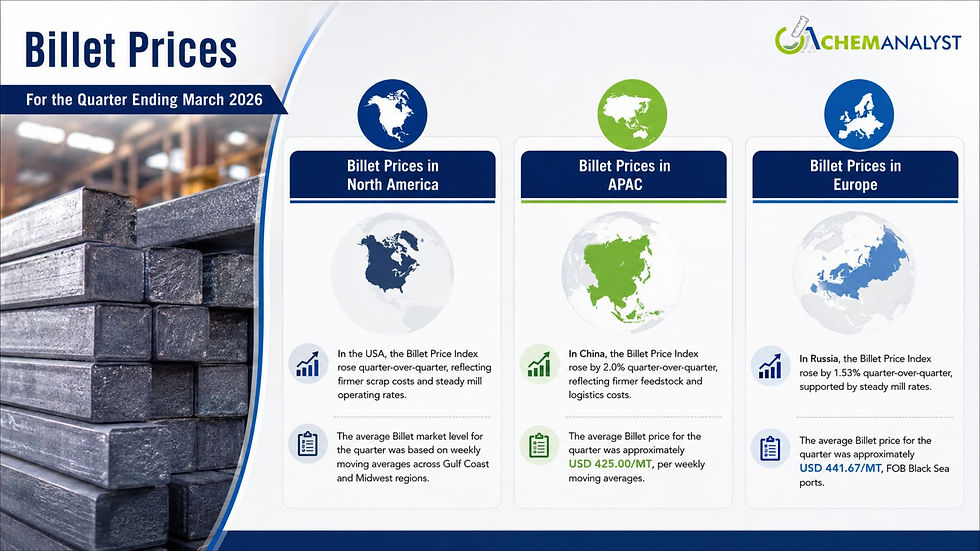
According to ChemAnalyst, The global billet prices recorded moderate upward momentum during the first quarter of 2026, supported by firm raw material costs, stable steel production activity, and balanced demand from downstream construction and manufacturing sectors. Billets, which serve as the primary semi-finished steel product used in the production of long steel products such as rebar, wire rods, and structural steel, remained an essential component of the global steel value chain.
During the quarter ending March 2026, billet prices increased across major producing regions including North America, Asia-Pacific, and Europe. Market participants observed steady procurement activity, controlled inventory levels, and moderate support from feedstock markets, contributing to price stability and gradual appreciation.
Global Billet Market Overview
Steel billets are intermediate steel products produced through continuous casting processes and subsequently rolled into finished steel products. The pricing of billets is influenced by several factors, including:
Scrap steel and iron ore costs
Energy and electricity prices
Transportation and logistics expenses
Steel mill operating rates
Construction sector demand
Manufacturing and infrastructure investments
Trade policies and export activities
In Q1 2026, the global billet market remained relatively balanced. While demand from infrastructure and industrial sectors continued to support consumption, producers faced increasing costs associated with raw materials and transportation. These factors collectively contributed to the upward movement in billet prices across major regions.
Book A Demo for Billet Price: https://www.chemanalyst.com/Pricing-data/billet-3061
Billet Prices in North America
United States Billet Market Performance
In the United States, the Billet Price Index increased quarter-over-quarter during Q1 2026. The price improvement was primarily attributed to firmer scrap steel costs and steady operating rates at domestic steel mills.
The North American steel industry entered 2026 with stable production schedules and consistent demand from key end-use sectors such as construction, automotive manufacturing, and industrial equipment production. As a result, billet producers maintained healthy order books throughout the quarter.
Higher scrap prices played a significant role in shaping billet market sentiment. Since electric arc furnace (EAF) steelmaking remains the dominant production route in the United States, fluctuations in scrap values directly affect billet production costs. The increase in scrap procurement costs encouraged mills to pass on higher expenses through billet pricing.
Supply and Demand Dynamics
Demand conditions remained supportive throughout the quarter. Construction projects across commercial, residential, and infrastructure segments continued to generate steady consumption of long steel products, thereby sustaining billet requirements.
Meanwhile, steel mills maintained relatively stable operating rates, preventing significant oversupply conditions. Controlled production volumes helped support market balance and limited downward pressure on prices.
The average billet market level for the quarter was determined based on weekly moving averages across the Gulf Coast and Midwest regions, which serve as important steel production and distribution hubs within the United States.
Key Factors Supporting Billet Prices in the USA
Firm scrap steel prices
Stable steel mill utilization rates
Consistent infrastructure-related demand
Healthy manufacturing sector activity
Balanced inventory levels
Stable domestic steel production
Looking ahead, market participants expect billet prices in North America to remain influenced by scrap market movements and construction sector activity.
Billet Prices in APAC
China Billet Market Analysis
China, the world's largest steel producer and consumer, recorded a 2.0% quarter-over-quarter increase in the Billet Price Index during Q1 2026. The rise was driven primarily by firmer feedstock costs and increasing logistics expenses.
The Chinese billet market entered the year with cautious optimism as government infrastructure initiatives and industrial investments continued to support steel consumption. While broader economic growth remained moderate, downstream demand showed signs of stabilization compared with previous quarters.
The average billet price during the quarter was approximately USD 425.00 per metric ton, based on weekly moving averages.
Impact of Feedstock Costs
Raw material pricing remained a major determinant of billet market trends in China. Rising costs for iron ore, coking coal, and other steelmaking inputs increased production expenses for steel mills.
Many producers adjusted billet selling prices upward to maintain operating margins amid these elevated input costs. As a result, the market experienced gradual but consistent price growth throughout the quarter.
Logistics and Transportation Challenges
Transportation expenses also contributed to the upward pricing trend. Freight costs, inland logistics charges, and distribution expenses increased across several industrial regions, impacting overall steel supply chain economics.
The movement of raw materials from mining regions to steel plants and finished products to consumers became more expensive, creating additional pricing pressure across the billet market.
Chinese Demand Conditions
Demand from infrastructure, machinery manufacturing, and construction sectors remained relatively stable during Q1 2026. Government-supported projects helped sustain steel consumption despite ongoing challenges in certain real estate segments.
Steel service centers and distributors maintained cautious purchasing strategies, avoiding excessive inventory accumulation while ensuring adequate material availability.
Major Market Drivers in China
Rising iron ore and coal costs
Higher logistics and transportation expenses
Stable infrastructure demand
Controlled production activity
Government investment programs
Balanced steel inventories
As China continues to influence global steel trade, movements in Chinese billet prices remain a critical benchmark for regional and international markets.
Billet Prices in Europe
Russia Billet Market Performance
In Russia, the Billet Price Index increased by 1.53% quarter-over-quarter during Q1 2026. The market benefited from steady steel mill operating rates and relatively stable export activity.
The average billet price for the quarter reached approximately USD 441.67 per metric ton on an FOB Black Sea basis, according to weekly moving averages.
Russia remains one of the leading exporters of steel billets globally, supplying material to markets across Europe, the Middle East, North Africa, and Asia. Consequently, export demand continues to play a significant role in determining domestic pricing trends.
Stable Mill Operations Support Market
Russian steel producers maintained consistent production schedules during the quarter, helping ensure reliable supply availability without creating excessive inventory pressure.
Stable mill utilization rates allowed producers to manage output efficiently while responding to export and domestic demand requirements.
This balanced production environment contributed to the moderate increase observed in billet prices.
Export Market Influence
International demand remained an important factor supporting billet pricing throughout the quarter. Export-oriented steel mills benefited from continued purchasing interest from overseas buyers seeking competitively priced semi-finished steel products.
The FOB Black Sea market remained a key pricing reference for global billet trade, influencing transactions across multiple destination markets.
Factors Affecting Russian Billet Prices
Steady steel mill operating rates
Stable export demand
Balanced supply conditions
Consistent production activity
Competitive positioning in global steel trade
Controlled inventory levels
The Russian billet market demonstrated resilience despite ongoing geopolitical and trade-related uncertainties affecting broader commodity markets.
Get Real Time Online for Billet prices: https://www.chemanalyst.com/ChemAnalyst/PricingForm?Product=Billet
Comparative Regional Billet Price Analysis
A comparison of regional billet market performance highlights varying degrees of price appreciation during Q1 2026.
Among the analyzed regions, China recorded the strongest percentage increase, driven primarily by rising feedstock and logistics costs. Russia followed with moderate gains supported by stable mill operations and export demand.
Meanwhile, the United States market experienced price growth due to firm scrap costs and consistent steel production activity.
Key Trends Shaping Global Billet Prices
Several major themes influenced billet pricing during Q1 2026:
Rising Production Costs
Increasing expenses for scrap steel, iron ore, coal, and energy continued to pressure steel producers globally. These higher costs translated into stronger billet pricing across most regions.
Infrastructure Development
Government-funded infrastructure projects remained an important source of steel demand, particularly in North America and Asia-Pacific markets.
Stable Steel Production
Most major steel-producing countries maintained relatively steady operating rates, helping preserve supply-demand balance.
Logistics Cost Inflation
Transportation and freight expenses increased in several regions, contributing to higher delivered steel costs and supporting billet prices.
Export Market Activity
International trade flows continued to influence pricing, particularly in export-oriented markets such as Russia and China.
Billet Price Outlook for Q2 2026
Looking ahead to the second quarter of 2026, market participants expect billet prices to remain supported by raw material costs and ongoing infrastructure demand.
Several factors are likely to determine future price direction:
Scrap steel price movements
Iron ore and coking coal trends
Energy market developments
Global construction activity
Infrastructure spending programs
Steel mill operating rates
Export demand conditions
If feedstock prices remain elevated and steel demand continues at current levels, billet prices could maintain a stable-to-firm trajectory through the upcoming quarter.
However, any significant slowdown in construction activity or weakening industrial demand could limit further price gains.
Conclusion
The global billet market demonstrated resilience during Q1 2026, with prices rising across North America, Asia-Pacific, and Europe. In the United States, stronger scrap costs and stable mill operations supported higher billet values. China recorded a 2.0% quarter-over-quarter increase due to rising feedstock and logistics expenses, while Russia witnessed a 1.53% gain supported by steady production rates and export demand.
As steel producers continue to navigate fluctuating raw material costs and evolving demand conditions, billet prices are expected to remain closely linked to developments in construction, manufacturing, and infrastructure sectors. Market participants will continue monitoring supply chain costs, production levels, and global trade activity to assess future billet price trends throughout 2026.
About Us:
Welcome to ChemAnalyst, a next–generation platform for chemical and petrochemical intelligence where innovation meets practical insight. Recognized as “Product Innovator of the Year 2023” and ranked among the “Top 100 Digital Procurement Solutions Companies,” we lead the digital transformation of the global chemical sector. Our online platform helps companies handle price volatility with structured analysis, real-time pricing, and reliable news and deal updates from across the world. Tracking over 500 chemical prices in more than 40 countries becomes simple and efficient with us.
Contact Us:
ChemAnalyst
United States
Call +1 3322586602
420 Lexington Avenue, Suite 300, New York, NY,
United States, 10170
Email: sales@chemanalyst.com
Website: https://www.chemanalyst.com/
Facebook: https://www.facebook.com/ChemAnalysts/
Twitter: https://x.com/chemanalysts
YouTube: https://www.youtube.com/@chemanalyst
Instagram: https://www.instagram.com/chemanalyst_


Comments